

What is the mixing time required for a sludge mixer to achieve the desired result?
As a supplier of sludge mixers, I've encountered numerous inquiries from customers about the mixing time needed to attain the desired outcomes. This is a crucial aspect, as it directly impacts the efficiency and effectiveness of sludge treatment processes. In this blog, I'll delve into the factors influencing the mixing time and provide some insights to help you understand this complex issue.

Factors Affecting Mixing Time
-
Sludge Characteristics
- The nature of the sludge plays a significant role in determining the mixing time. For instance, if the sludge has a high viscosity, it will be more challenging to mix compared to a less viscous one. High - viscosity sludge resists the movement of the mixer blades, requiring more time for the mixer to distribute additives or achieve a homogeneous blend.
- The particle size distribution in the sludge also matters. If the sludge contains large particles, these may take longer to break down and disperse evenly throughout the mixture. On the other hand, a sludge with a more uniform and fine particle size will generally mix more quickly.
-
Mixer Design and Capacity
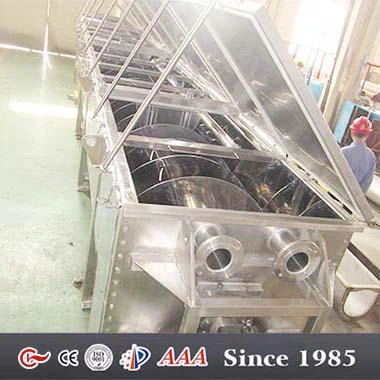
- The design of the sludge mixer is a key factor. Different types of mixers, such as paddle mixers, screw conveyors, and ribbon mixers, have varying mixing mechanisms and efficiencies. For example, a Sludge Mixer Mixing Screw Conveyors uses a rotating screw to move and mix the sludge. The shape, pitch, and speed of the screw can all affect how fast the mixing occurs.
- The capacity of the mixer is also important. A larger - capacity mixer may take longer to mix the same volume of sludge compared to a smaller one, especially if the power input per unit volume is not sufficient. However, a well - designed large - capacity mixer can be more efficient in terms of overall throughput.
-
Additives and Their Dosage
- When additives are introduced into the sludge, the mixing time can be significantly affected. For example, if a flocculant is added to the sludge to promote particle aggregation, the mixer needs to ensure that the flocculant is evenly distributed throughout the sludge. The dosage of the additive also matters; a higher dosage may require more time to mix properly.
- Some additives may react with the sludge components, and the mixing time should be long enough to allow these reactions to occur fully. This ensures that the desired treatment effect, such as improved dewaterability or reduced odor, is achieved.
-
Desired Mixing Result
- The specific outcome you want from the mixing process determines the required mixing time. If the goal is simply to blend two or more substances in the sludge, a relatively short mixing time may be sufficient. However, if you need to achieve a high level of homogeneity, such as a uniform distribution of a chemical additive at a molecular level, a much longer mixing time will be necessary.
Estimating Mixing Time
To estimate the mixing time for a sludge mixer, it's often useful to conduct pilot - scale tests. These tests involve using a small - scale version of the mixer to mix a sample of the sludge under controlled conditions. By varying the mixing time and analyzing the results, you can get a better understanding of how long it takes to achieve the desired outcome.
In some cases, empirical formulas can also be used as a starting point. However, these formulas are often based on general assumptions and may not be applicable to all types of sludge and mixers. For example, a simple formula might relate the mixing time to the volume of the sludge, the power input of the mixer, and the viscosity of the sludge. But in reality, the complex interactions between the sludge components and the mixer design make these formulas less accurate.
Another approach is to refer to industry standards and case studies. Many industries have established guidelines for sludge mixing based on years of experience. For example, in the wastewater treatment industry, there are recommended mixing times for different types of sludge treatment processes. Case studies of similar sludge treatment projects can also provide valuable insights into the mixing time required for specific applications.
Importance of Optimizing Mixing Time
Optimizing the mixing time is crucial for several reasons. Firstly, it directly affects the operational cost of the sludge treatment process. A longer than necessary mixing time means more energy consumption, which increases the overall cost. On the other hand, if the mixing time is too short, the desired treatment effect may not be achieved, leading to additional costs for re - treatment or reduced efficiency in downstream processes.
Secondly, proper mixing time ensures the quality of the treated sludge. For example, in sludge dewatering processes, if the flocculant is not mixed evenly, the dewatering efficiency will be low, resulting in higher moisture content in the dewatered sludge. This can cause problems in sludge disposal or further treatment.
Case Study: A Coffee - related Application
Let's take a look at a different but related application. Consider a Conveyor Screw Coffee Screw Ribbon Mixer for Coffee System. In this case, the mixing time is also a critical factor. The coffee beans, along with any additives such as flavorings or preservatives, need to be mixed thoroughly. The mixing time will depend on the type of coffee beans (their size, density, and moisture content), the design of the mixer, and the desired flavor profile.
Just like in sludge mixing, the goal is to achieve a homogeneous mixture. If the mixing time is too short, the flavor may not be evenly distributed, and the quality of the coffee product will be affected. By carefully controlling the mixing time, coffee producers can ensure a consistent and high - quality product.
Conclusion
In conclusion, the mixing time required for a sludge mixer to achieve the desired result is influenced by multiple factors, including sludge characteristics, mixer design, additives, and the desired outcome. Estimating the mixing time accurately often requires a combination of pilot - scale tests, empirical knowledge, and reference to industry standards.
Optimizing the mixing time is essential for cost - effective and high - quality sludge treatment. As a sludge mixer supplier, I'm committed to helping our customers understand these factors and select the right mixer for their specific needs. If you're in the process of choosing a sludge mixer or need advice on optimizing your sludge mixing process, I encourage you to reach out to us for further discussion and procurement. We can work together to ensure that your sludge treatment operations are efficient and successful.
References
- "Sludge Treatment Handbook" - A comprehensive guide on sludge treatment processes and technologies.
- Industry reports on wastewater treatment and sludge management from relevant professional organizations.
- Research papers on the hydrodynamics of sludge mixing and the effects of additives on sludge properties.