

When it comes to custom mixers, one of the most critical components is the mixing blade. Different applications demand different types of mixing blades to ensure efficient and thorough mixing. As a custom mixer supplier, we understand the diverse needs of our clients and offer a wide range of mixing blades tailored to specific requirements. In this blog, we will explore the various kinds of mixing blades available for our custom mixers.
Paddle Blades
Paddle blades are one of the most common types of mixing blades used in custom mixers. They are typically flat or slightly curved and are attached to the mixer shaft. Paddle blades are ideal for gentle mixing applications where the material needs to be blended without excessive shearing. They work by moving the material in a radial and axial direction, promoting a gentle turnover of the mixture.
The design of paddle blades can vary depending on the specific application. For example, in some cases, the paddles may be offset to create a more turbulent flow, while in others, they may be straight to provide a more gentle mixing action. Paddle blades are commonly used in food processing, pharmaceuticals, and chemical industries for mixing powders, granules, and pastes.
Propeller Blades
Propeller blades are another popular choice for custom mixers, especially in applications where high-speed mixing is required. They are designed to create a strong axial flow, which helps to quickly disperse and blend the materials. Propeller blades are typically made of three or four blades that are angled to generate a powerful pumping action.
The efficiency of propeller blades depends on their diameter, pitch, and rotational speed. A larger diameter blade can cover a larger area, while a higher pitch can increase the pumping capacity. Propeller blades are commonly used in liquid mixing applications, such as in the chemical, pharmaceutical, and water treatment industries. They are also suitable for mixing low-viscosity materials and creating homogeneous solutions.
Turbine Blades
Turbine blades are similar to propeller blades but are designed to create a more radial flow. They are typically made of multiple blades that are curved and angled to generate a high-shear mixing action. Turbine blades are ideal for applications where the material needs to be thoroughly mixed and dispersed, such as in emulsification and suspension processes.
The design of turbine blades can vary depending on the specific application. For example, in some cases, the blades may be flat to create a more turbulent flow, while in others, they may be curved to provide a more gentle mixing action. Turbine blades are commonly used in the food, beverage, and cosmetic industries for mixing liquids, creams, and lotions.
Anchor Blades
Anchor blades are designed to provide a slow, gentle mixing action, making them ideal for applications where the material needs to be mixed without excessive shearing. They are typically made of a single blade that is shaped like an anchor and is attached to the mixer shaft. Anchor blades work by moving the material in a circular motion, promoting a gentle turnover of the mixture.
The design of anchor blades can vary depending on the specific application. For example, in some cases, the blade may be offset to create a more turbulent flow, while in others, it may be straight to provide a more gentle mixing action. Anchor blades are commonly used in the food, pharmaceutical, and chemical industries for mixing viscous materials, such as pastes, gels, and creams.
Helical Blades
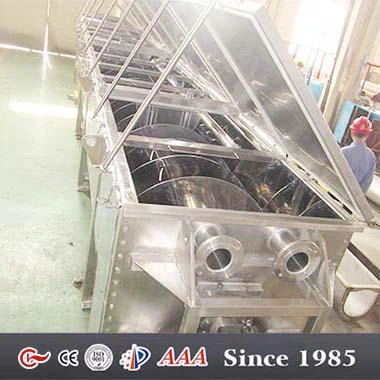
Helical blades are designed to provide a high-shear mixing action, making them ideal for applications where the material needs to be thoroughly mixed and dispersed. They are typically made of a single blade that is shaped like a helix and is attached to the mixer shaft. Helical blades work by moving the material in a spiral motion, promoting a thorough mixing of the mixture.
The design of helical blades can vary depending on the specific application. For example, in some cases, the blade may be pitched to create a more turbulent flow, while in others, it may be straight to provide a more gentle mixing action. Helical blades are commonly used in the food, pharmaceutical, and chemical industries for mixing powders, granules, and pastes.
Ribbon Blades
Ribbon blades are designed to provide a continuous mixing action, making them ideal for applications where the material needs to be continuously mixed and conveyed. They are typically made of a single blade that is shaped like a ribbon and is attached to the mixer shaft. Ribbon blades work by moving the material in a helical motion, promoting a continuous mixing and conveying of the mixture.
The design of ribbon blades can vary depending on the specific application. For example, in some cases, the blade may be double ribbon to create a more efficient mixing action, while in others, it may be single ribbon to provide a more gentle mixing action. Ribbon blades are commonly used in the food, pharmaceutical, and chemical industries for mixing powders, granules, and pastes.
Specialized Blades
In addition to the standard mixing blades mentioned above, we also offer a range of specialized blades for custom mixers. These blades are designed to meet the specific needs of our clients and are often used in unique applications. Some examples of specialized blades include:

- Cutting blades: These blades are designed to cut and shear the material, making them ideal for applications where the material needs to be broken down into smaller particles.
- Dispersing blades: These blades are designed to disperse and homogenize the material, making them ideal for applications where the material needs to be evenly distributed throughout the mixture.
- Agitator blades: These blades are designed to create a gentle agitation of the material, making them ideal for applications where the material needs to be kept in suspension or stirred gently.
Conclusion
Choosing the right mixing blade for your custom mixer is crucial to ensure efficient and thorough mixing. As a custom mixer supplier, we offer a wide range of mixing blades tailored to specific requirements. Whether you need a paddle blade for gentle mixing, a propeller blade for high-speed mixing, or a specialized blade for a unique application, we have the solution for you.
If you are interested in learning more about our custom mixers and the mixing blades we offer, please visit our website at /mixer/conveyor-screw-coffee-screw-ribbon-mixer-for.html to explore our Conveyor Screw Coffee Screw Ribbon Mixer for Coffee System or /mixer/sludge-mixer-mixing-screw-conveyors.html to learn about our Sludge Mixer Mixing Screw Conveyors. Our team of experts is also available to assist you in choosing the right mixing blade for your specific application. Contact us today to start the procurement and negotiation process.
References
- Perry, R. H., & Green, D. W. (2008). Perry's Chemical Engineers' Handbook. McGraw-Hill.
- Oldshue, J. Y. (1983). Fluid Mixing Technology. McGraw-Hill.
- Levenspiel, O. (1999). Chemical Reaction Engineering. Wiley.