

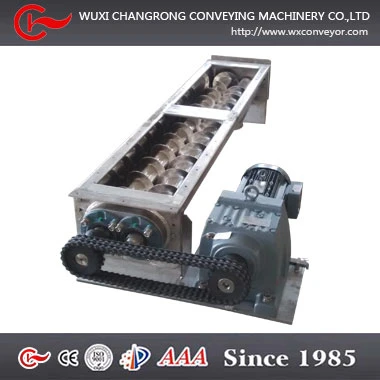
What is the speed ratio of a worm conveyor? Well, I'm here as a worm conveyor supplier to break it down for you. First off, let's understand what a worm conveyor is. A worm conveyor, also known as a screw conveyor, is a simple yet effective device used to move bulk materials from one place to another. It consists of a helical screw blade (the "worm") rotating inside a trough or tube.
Now, the speed ratio of a worm conveyor is a crucial factor that determines how efficiently it can move materials. The speed ratio is essentially the relationship between the rotational speed of the screw and the linear speed at which the material is conveyed.
To calculate the speed ratio, we need to consider a few key elements. The pitch of the screw is one of the most important factors. The pitch is the distance between adjacent threads on the screw. A larger pitch means that for each revolution of the screw, the material will be moved a greater distance along the conveyor. So, if we have a screw with a pitch of 100mm, for every full rotation of the screw, the material will theoretically move 100mm along the conveyor.
The rotational speed of the screw is usually measured in revolutions per minute (RPM). Let's say we have a screw rotating at 50 RPM. If the pitch is 100mm, then the linear speed of the material can be calculated by multiplying the pitch by the RPM. So, in this case, the linear speed would be 50 x 100 = 5000mm per minute or 5 meters per minute.
However, in real - world scenarios, the actual speed at which the material is conveyed can be different from the theoretical value. There are several factors that can affect this. One of the main factors is the friction between the material and the screw, as well as between the material and the trough or tube. If the material is sticky or has a high coefficient of friction, it may not move as smoothly along the conveyor, and the actual linear speed will be lower than the theoretical value.
Another factor is the angle of the conveyor. If the conveyor is inclined, gravity will either assist or oppose the movement of the material. For an inclined conveyor, we need to take into account the component of the gravitational force acting along the direction of the conveyor. If the conveyor is going uphill, the gravitational force will act against the movement of the material, and we may need to increase the rotational speed of the screw to maintain the desired linear speed.
Let's talk about some of the different types of worm conveyors and how their speed ratios might vary. For example, a Silo Screw Conveyor is often used to transfer materials from silos. These conveyors may need to have a specific speed ratio depending on the rate at which the material needs to be discharged from the silo. If the material is being used in a continuous process downstream, the speed ratio of the silo screw conveyor needs to be carefully adjusted to match the demand of the process.
A Horizontal Screw Feeder is used to feed materials horizontally at a controlled rate. The speed ratio of a horizontal screw feeder is important for accurate metering of the material. If the speed ratio is too high, the material may be fed too quickly, leading to over - feeding and potential problems in the downstream process. On the other hand, if the speed ratio is too low, the material may not be fed at a sufficient rate, causing production delays.
A Feed Screw Conveyor is designed to provide a consistent flow of material. The speed ratio of a feed screw conveyor is crucial for maintaining a uniform feed rate. This is especially important in applications where precise amounts of material need to be added to a process, such as in the food or pharmaceutical industries.
When choosing a worm conveyor, it's essential to select the right speed ratio for your specific application. You need to consider the type of material you're conveying, the distance it needs to be moved, the required throughput, and any other specific requirements of your process.
If you're unsure about what speed ratio is best for your application, don't worry. As a worm conveyor supplier, I have the expertise and experience to help you make the right choice. We can analyze your requirements, take into account all the relevant factors, and recommend a worm conveyor with the optimal speed ratio for your needs.
Whether you're looking for a silo screw conveyor, a horizontal screw feeder, or a feed screw conveyor, we've got you covered. Our conveyors are built to high - quality standards, ensuring reliable and efficient operation.
If you're interested in learning more about our worm conveyors or would like to discuss your specific requirements for a particular speed ratio, feel free to get in touch with us. We're here to help you find the perfect solution for your material handling needs. Let's start a conversation and see how we can work together to improve your production process.
References

- "Screw Conveyor Handbook", published by an industry - leading materials handling association
- Technical papers on screw conveyor design and operation from well - known engineering journals