

Hey there! As a supplier for mixer factories, I've had the chance to peek into all sorts of these places. You might be wondering, "What's the size of a typical mixer factory?" Well, there's no one - size - fits - all answer, and I'm gonna break it down for you.
First off, let's talk about what we mean by "size." We could be talking about the physical area of the factory, the number of employees, or the production capacity. And trust me, these things can vary a whole lot depending on a bunch of factors.
Physical Area
When it comes to the physical size of a mixer factory, it can range from a small, compact space to a huge industrial complex. A small - scale mixer factory might occupy an area of around 500 to 1,500 square meters. These are usually family - owned or startup operations. They're great for making custom - made mixers or catering to a niche market. For example, if you're into making high - end, artisanal mixers for small - batch coffee roasters, a smaller factory can do the job just fine.
On the other hand, large - scale mixer factories can span over 10,000 square meters or even more. These are the big players in the industry. They have the space to house multiple production lines, large storage areas for raw materials, and even dedicated research and development departments. They're often geared towards mass - producing mixers for a wide range of industries, like food processing, chemical manufacturing, and construction.
Number of Employees
The number of employees in a mixer factory also gives us an idea of its size. A small factory might have a team of just 5 to 20 people. These employees wear many hats, from operating the machinery to handling sales and customer service. They're like a tight - knit family, working together to keep the business running smoothly.
In contrast, a large mixer factory can employ hundreds or even thousands of workers. You've got different departments for everything - design, production, quality control, marketing, and logistics. Each employee has a specific role, and the factory runs like a well - oiled machine. For instance, in a large factory, you might have a team of engineers constantly working on improving the mixer designs, while another team is focused on ensuring that every product meets the strict quality standards.
Production Capacity
Production capacity is probably the most important factor when it comes to defining the size of a mixer factory. A small factory might be able to produce anywhere from 10 to 100 mixers per month. These are usually made to order, and the focus is on quality and customization. They might take longer to produce each mixer, but the end result is a product that exactly meets the customer's needs.

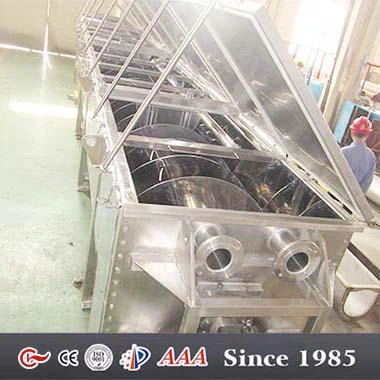
Large factories, however, can crank out thousands of mixers per month. They use automated production lines and advanced manufacturing techniques to increase efficiency. For example, they can produce standard - sized mixers in large quantities, which are then sold to distributors around the world.
Factors Affecting Factory Size
There are several factors that influence the size of a mixer factory. One of the biggest factors is the target market. If the factory is aiming at a local or regional market, it might not need to be as large as one that wants to go global. A factory that serves a local coffee shop might only need to produce a few mixers at a time, while a factory targeting international food manufacturers will need to have a much larger production capacity.
Another factor is the type of mixers being produced. Some mixers, like the Conveyor Screw Coffee Screw Ribbon Mixer for Coffee System, are more complex and require more space and specialized equipment to manufacture. These factories need to be larger to accommodate the production process. On the other hand, simpler mixers, like small - scale household mixers, can be produced in a smaller factory.
The availability of resources also plays a role. If a factory has easy access to raw materials, labor, and capital, it's more likely to expand. For example, a factory located near a major industrial hub will have better access to suppliers and a larger pool of skilled workers, which can support a larger operation.
Case Studies
Let's take a look at a couple of case studies to better understand the different sizes of mixer factories.
Small - Scale Factory: Artisan Mixers Inc.
This small factory is located in a quiet town. It has an area of about 800 square meters and employs 12 people. They specialize in making high - quality, hand - crafted mixers for small coffee shops. Their production capacity is around 30 mixers per month. Each mixer is made with great attention to detail, and they offer a high level of customization. They might not be able to compete with the big players in terms of quantity, but their customers love the unique and well - made products.
Large - Scale Factory: Global Mixers Ltd.
Global Mixers is a huge factory that covers an area of over 15,000 square meters. They have a workforce of over 500 employees and produce around 5,000 mixers per month. They make a wide range of mixers, from industrial - grade Sludge Mixer Mixing Screw Conveyors to standard household mixers. They use the latest technology and have a well - established distribution network that reaches all corners of the world.
Why Size Matters
The size of a mixer factory matters for both the factory owners and the customers. For factory owners, a larger factory can mean more production capacity, which in turn can lead to higher profits. It also allows them to invest in research and development, which can help them stay ahead of the competition.
For customers, the size of the factory can affect the quality, price, and delivery time of the mixers. A small factory might offer more personalized service and higher - quality products, but they might take longer to deliver. A large factory can offer lower prices due to economies of scale and faster delivery times, but the level of customization might be limited.
Connect with Us
If you're in the market for mixers, whether you're a small business looking for a custom - made mixer or a large corporation in need of mass - produced units, we're here to help. We've got connections with mixer factories of all sizes, and we can find the perfect solution for you. Don't hesitate to reach out to us for more information and to start the procurement process. We're ready to have a chat and work out the best deal for you.
References
- Industry reports on mixer manufacturing
- Interviews with mixer factory owners and managers