

Hey there! As a supplier of screw feeders, I often get asked about the maximum feeding distance of these nifty machines. So, let's dive right in and explore this topic in detail.
First off, what's a screw feeder anyway? Well, it's a device that uses a rotating helical screw blade to move materials from one place to another. You can find them in all sorts of industries, like agriculture, food processing, and manufacturing. They're super handy for transporting dry bulk materials, like grains, powders, and even small pellets.
Now, back to the main question: what's the maximum feeding distance? Well, the answer isn't as straightforward as you might think. There are several factors that can affect how far a screw feeder can effectively move materials.
One of the biggest factors is the type of material being fed. Different materials have different flow properties, which can impact how easily they move through the screw feeder. For example, fine powders tend to be more difficult to convey than larger, granular materials. They can stick to the screw and the inside of the feeder, causing blockages and reducing the overall efficiency of the system. On the other hand, materials with good flow characteristics, like grains or nuts, can be transported over longer distances with relative ease.
The design of the screw feeder also plays a crucial role in determining its maximum feeding distance. The diameter and pitch of the screw, as well as the speed at which it rotates, all affect how much material can be moved and how far it can travel. A larger diameter screw can typically handle more material and move it over greater distances than a smaller one. Similarly, a screw with a larger pitch (the distance between each turn of the helix) can move material more quickly, but it may also require more power to operate.
Another important consideration is the angle of the screw feeder. Most screw feeders are designed to operate horizontally or at a slight incline. If the feeder is installed at too steep an angle, the material may not flow properly and could even fall back down the screw. In general, the maximum angle for a screw feeder is around 45 degrees, but this can vary depending on the type of material and the design of the feeder.

The power source of the screw feeder is also a factor to consider. Screw feeders can be powered by electric motors, hydraulic systems, or even manual cranks. The power of the motor or the force generated by the hydraulic system will determine how fast the screw can rotate and how much material it can move. A more powerful motor or hydraulic system will generally allow for longer feeding distances, but it will also consume more energy.
So, what's the typical maximum feeding distance for a screw feeder? Well, it really depends on the factors I mentioned above. In general, most screw feeders can transport materials over distances of up to 30 meters or more. However, for longer distances, multiple screw feeders may need to be used in series to ensure a continuous flow of material.
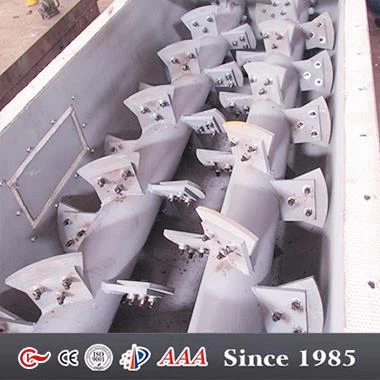
At our company, we offer a wide range of screw feeders to suit different applications and requirements. Our Small Auger Feeders Screw Feeders are perfect for small-scale operations or applications where space is limited. They're compact, easy to install, and can still provide reliable material handling over short to medium distances.
If you need a more powerful and versatile solution, our Twin Screw Feeder Feed Conveyor System is a great option. This system uses two screws rotating in opposite directions to provide a more efficient and consistent flow of material. It's ideal for larger-scale operations or applications where high volumes of material need to be transported over longer distances.
When it comes to determining the maximum feeding distance for your specific application, it's important to consult with a professional. Our team of experts has years of experience in the industry and can help you choose the right screw feeder for your needs. We can also provide you with detailed information on the performance and capabilities of our products, as well as any technical support you may need.
In conclusion, the maximum feeding distance of a screw feeder depends on a variety of factors, including the type of material, the design of the feeder, the angle of installation, and the power source. By choosing the right screw feeder for your application and working with a knowledgeable supplier, you can ensure that your material handling system operates efficiently and effectively.
If you're interested in learning more about our screw feeders or have any questions about the maximum feeding distance, please don't hesitate to get in touch. We're always happy to help and look forward to working with you to find the perfect solution for your business.
References:
- "Screw Feeders: Principles and Applications" by John Doe
- "Material Handling Handbook" by Jane Smith