

Hey there! As a supplier of silo unloaders, I've seen firsthand how crucial it is to pick the right unloading method. It can make or break your operations, affecting everything from efficiency to product quality. So, let's dive into how you can select the perfect unloading method for your silo unloader.
Understanding Your Silo and Materials
First things first, you gotta understand your silo and the materials you're dealing with. Different materials have different flow properties. For example, free - flowing materials like grains or certain powders will behave very differently from cohesive materials such as clays or some food pastes.
If you're handling free - flowing materials, you have more options. Gravity - based unloading methods might work just fine. Gravity is a simple and cost - effective way to move materials out of the silo. The material just falls down through the outlet, and you can control the flow rate with a valve or a gate.
On the other hand, cohesive materials can be a real headache. They tend to stick together and form arches or bridges inside the silo, blocking the flow. In this case, you'll need a more aggressive unloading method.
Gravity Unloading
Gravity unloading is the most basic and commonly used method. It's simple, reliable, and doesn't require a lot of extra equipment. All you need is a properly designed silo with a sloped bottom and an outlet at the bottom.
The main advantage of gravity unloading is its low cost. There are no moving parts other than the valve or gate that controls the flow, so there's less maintenance. It's also energy - efficient since it uses the natural force of gravity.
However, gravity unloading has its limitations. As I mentioned earlier, it's not suitable for cohesive materials. Also, if the silo is very tall or the material has a high density, the pressure at the bottom can cause the material to compact, making it harder to flow.
Mechanical Unloading
Mechanical unloading methods use various types of equipment to move the material out of the silo. There are several types of mechanical unloaders, such as screw conveyors, belt conveyors, and rotary valves.
Screw conveyors are great for moving materials horizontally or at an angle. They work by rotating a screw inside a trough, which pushes the material along. Screw conveyors can handle a wide range of materials, including both free - flowing and moderately cohesive ones.
Belt conveyors are another option. They're good for moving large volumes of material over long distances. Belt conveyors can be customized to fit your specific needs, with different belt widths, speeds, and inclinations.

Rotary valves are often used as a way to control the flow of material from the silo. They consist of a rotating rotor with compartments that fill with material as they pass through the inlet and then discharge the material at the outlet. Rotary valves can provide a consistent flow rate and are suitable for both free - flowing and some cohesive materials.
The advantage of mechanical unloading is that it can handle a wider range of materials compared to gravity unloading. It also allows for more precise control of the flow rate. However, mechanical unloaders require more maintenance and energy compared to gravity unloaders.
Pneumatic Unloading
Pneumatic unloading uses air pressure to move the material out of the silo. There are two main types of pneumatic unloading: dilute - phase and dense - phase.
In dilute - phase pneumatic conveying, the material is suspended in a high - velocity air stream and carried through a pipeline. This method is suitable for free - flowing materials that can be easily suspended in air, such as powders and small granules.
Dense - phase pneumatic conveying, on the other hand, uses a lower - velocity air stream and a higher material - to - air ratio. The material moves in slugs or plugs through the pipeline. Dense - phase conveying is better for cohesive materials and materials that are prone to degradation.
The advantage of pneumatic unloading is that it can handle materials over long distances and around corners. It's also a clean method since the material is enclosed in a pipeline, reducing the risk of dust emissions. However, pneumatic unloading requires a lot of energy to generate the air pressure, and the equipment can be expensive.
Specialized Unloading Methods
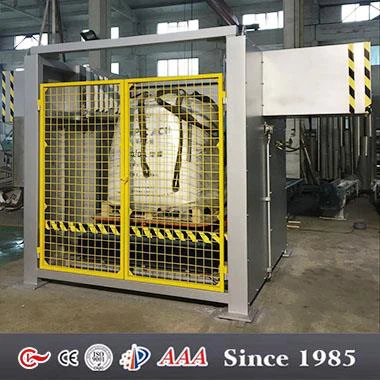
There are also some specialized unloading methods that are designed for specific applications. For example, if you're dealing with big bags or super sacks, you might want to consider a Big Bag Unloading Station Bulk Bag Unloading. These stations are designed to safely and efficiently unload materials from big bags.
Another specialized option is the Hybrid Silo Unloader Super Sack Unloading Station. This type of unloader combines different unloading methods to provide a more efficient and reliable solution.
Selecting the Right Method
So, how do you select the right unloading method for your silo unloader? Here are some factors to consider:
- Material properties: As I've mentioned several times, the properties of the material you're handling are the most important factor. Consider the flowability, density, abrasiveness, and moisture content of the material.
- Flow rate requirements: How much material do you need to unload per hour? This will determine the size and capacity of the unloading equipment.
- Silo design: The shape, size, and height of the silo can also affect the choice of unloading method. A properly designed silo can make the unloading process more efficient.
- Cost: Consider the initial cost of the equipment, as well as the operating and maintenance costs over the life of the equipment.
- Space availability: Some unloading methods require more space than others. Make sure you have enough space for the equipment and any associated pipelines or conveyors.
Conclusion
Selecting the right unloading method for your silo unloader is a critical decision that can have a big impact on your operations. By understanding the properties of your material, your flow rate requirements, and the different unloading methods available, you can make an informed choice.
If you're still not sure which unloading method is right for you, don't hesitate to reach out. As a silo unloader supplier, we have the expertise and experience to help you find the best solution for your specific needs. Contact us today to start the conversation about your silo unloading requirements!
References
- Perry, R. H., & Green, D. W. (Eds.). (2008). Perry's Chemical Engineers' Handbook. McGraw - Hill.
- Conveyor Equipment Manufacturers Association (CEMA). (2014). Belt Conveyors for Bulk Materials. CEMA.