

When it comes to industrial equipment, mixers are essential tools with a wide range of applications across various sectors. As a mixer price supplier, I often get asked about the cost of mixers that can serve multiple purposes. In this blog, I'll delve into the factors that influence the price of a versatile mixer and provide you with a general idea of what you might expect to pay.

Understanding the Versatility of Mixers
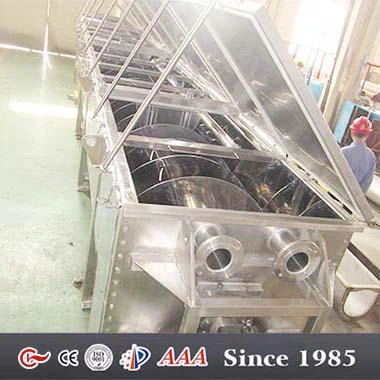
A mixer with a wide range of applications is designed to handle different types of materials, from dry powders to viscous liquids. These mixers can be used in industries such as food processing, chemical manufacturing, pharmaceuticals, and construction. For example, a Sludge Mixer Mixing Screw Conveyors is commonly used in wastewater treatment plants to blend sludge and additives, while a Conveyor Screw Coffee Screw Ribbon Mixer for Coffee System is ideal for the coffee industry to mix coffee beans and flavorings.

Factors Affecting the Cost of a Versatile Mixer
- Size and Capacity
- The size of the mixer, which is often determined by its capacity, is a major factor in pricing. Larger mixers that can handle more material at once generally cost more. For instance, a small - scale laboratory mixer with a capacity of a few liters may cost a few hundred dollars, while an industrial - sized mixer with a capacity of several cubic meters can cost tens of thousands of dollars.
- Material of Construction
- The materials used to build the mixer also impact its price. Mixers made from high - quality stainless steel are more expensive than those made from mild steel. Stainless steel is corrosion - resistant, which makes it suitable for applications where hygiene is crucial, such as in the food and pharmaceutical industries. On the other hand, mild steel is more economical but may require additional coatings or maintenance to prevent rust.
- Mixing Mechanism
- Different mixing mechanisms have different costs associated with them. For example, a simple paddle mixer, which has a relatively straightforward design, is usually less expensive than a more complex high - shear mixer. High - shear mixers are capable of breaking down particles and achieving a more homogeneous mixture, but they require more advanced technology and engineering, thus increasing the price.
- Automation and Control Features
- Mixers with advanced automation and control features are more costly. These features can include programmable logic controllers (PLCs), variable frequency drives (VFDs), and touch - screen interfaces. Automation allows for more precise control of the mixing process, such as adjusting the mixing speed, time, and temperature. This is especially important in industries where consistency and quality are critical.
Price Range of Versatile Mixers
Based on the factors mentioned above, the price of a mixer with a wide range of applications can vary significantly. - Entry - Level Mixers - For small - scale businesses or hobbyists, entry - level mixers can be found in the range of $500 - $5,000. These mixers typically have a small capacity, basic mixing mechanisms, and are made from more common materials. They are suitable for simple mixing tasks, such as mixing small batches of paint or dough. - Mid - Range Mixers - Mid - range mixers, which are commonly used in medium - sized industrial operations, usually cost between $5,000 and $20,000. These mixers offer a good balance between capacity, material quality, and mixing performance. They may have some automation features and can handle a wider variety of materials. - High - End Mixers - High - end mixers, designed for large - scale industrial applications and complex mixing requirements, can cost upwards of $20,000. These mixers are often made from premium materials, have advanced mixing mechanisms, and come with extensive automation and control systems. They are capable of handling high - volume production and achieving extremely precise mixing results.
Cost - Benefit Analysis
When considering the cost of a mixer, it's important to conduct a cost - benefit analysis. A more expensive mixer may offer better performance, durability, and efficiency in the long run. For example, a high - shear mixer may have a higher upfront cost but can reduce production time and improve product quality, resulting in cost savings over time. On the other hand, if your mixing requirements are relatively simple and the production volume is low, an entry - level mixer may be a more cost - effective choice.
Customization and Additional Costs
In addition to the base price of the mixer, there may be additional costs for customization. If you need a mixer with specific dimensions, mixing capabilities, or safety features, the manufacturer may need to make custom modifications. These modifications can add to the overall cost of the mixer.
There may also be costs associated with installation, training, and maintenance. Professional installation ensures that the mixer is set up correctly and operates safely. Training for your staff on how to use and maintain the mixer is also essential to maximize its lifespan and performance. Regular maintenance, including parts replacement and lubrication, is necessary to keep the mixer in good working condition.

Conclusion
The cost of a mixer with a wide range of applications can vary greatly depending on factors such as size, material of construction, mixing mechanism, and automation features. As a mixer price supplier, I understand that each customer has unique requirements and budget constraints. Whether you're looking for an entry - level mixer for a small business or a high - end mixer for a large - scale industrial operation, we can help you find the right mixer at a competitive price.
If you're interested in purchasing a mixer or need more information about our products and pricing, please feel free to reach out to us for a detailed quote. Our team of experts is ready to assist you in making the best decision for your business.
References
- "Industrial Mixers: Selection, Design, and Operation" by Paul R. Van de Vusse and Thijs J. H. Vlugter.
- "Mixing in the Process Industries" by H. P. Nienow.